Owning a listed building means owning a structure that handles water in a fundamentally different way to a modern house. Treat it like a modern house and you will make the damp worse, sometimes at considerable expense and occasionally in ways that cannot be undone.
Most damp problems in listed buildings have very little to do with the age of the building. They are caused by something well-intentioned that somebody did to it in the last sixty years.
What is a listed building?
A listed building appears on the National Heritage List for England, or on the equivalent registers maintained in Scotland, Wales and Northern Ireland, because of its architectural or historic interest.
Grade II covers the large majority of listings, with Grade II* and Grade I marking progressively greater significance.
The point owners most often misunderstand is scope. Listing applies to the whole building, inside and out, and it generally extends to structures within the curtilage such as outbuildings, garden walls and stables. It covers interior plasterwork, joinery, floors, staircases and fireplaces, not simply the front elevation you can see from the road.
Carrying out works that affect the special interest of a listed building without consent is a criminal offence, and local authorities can require unauthorised work to be reversed at the owner’s expense. None of that is a reason to leave damp untreated. It is a reason to plan properly before anybody lifts a hammer.
Why heritage buildings get wet differently
Modern construction keeps water out. A cavity wall, a damp proof course, a membrane beneath the floor and an impermeable render together form a barrier, and the building stays dry by resisting moisture at every point.
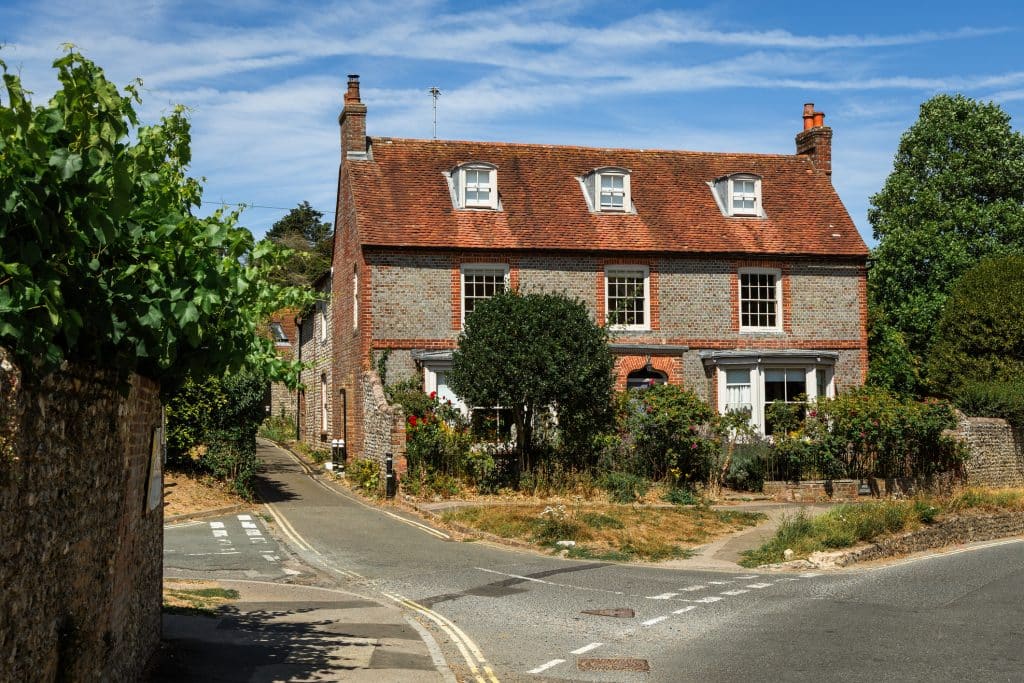
Traditional construction manages water instead of resisting it. Solid walls of stone, soft brick, cob or timber frame, bedded in lime mortar and finished with lime plaster and limewash, absorb moisture during wet weather and then release it back into the air when conditions allow. The wall gets damp and then dries out again, over and over, and that cycle is precisely how it was designed to work.
Most listed buildings also have no damp proof course, because none was ever fitted. That is normal rather than a defect, and it does not mean the building has a problem. It was built to cope through evaporation, generous roof overhangs, good drainage, and being kept warm and ventilated by its occupants.
Breathability and the “moisture cycle” in old walls
Breathability is the single most important idea in old-building damp, and it is worth being precise about what it means.
A traditional wall needs to be able to evaporate moisture from both faces. Water that arrives, whether from driving rain on the outside or from humid air on the inside, has to be able to leave again. Lime mortar, lime plaster, limewash and mineral paints all allow water vapour to pass through them. The moisture moves in, and then it moves back out.
Block that evaporation on either face and the moisture has nowhere to go. It does not simply stop arriving. It moves further into the wall, travels higher, and eventually emerges wherever it can find a route, which is almost always somewhere inside your house, usually at the base of a wall or in the corner of a room.
This is why so many damp problems in listed buildings appear on the inside face of a wall that has recently been rendered on the outside, and why the render is very rarely blamed.
How upgrades can unintentionally change moisture behaviour
Almost every serious damp problem in a listed building traces back to one of the following, and all of them were carried out by somebody trying to help.
Cement render and cement pointing are the worst offenders by a distance. Cement is hard, brittle and close to impermeable. Applied over soft brick or stone it traps moisture behind it, forces evaporation to happen somewhere else, and cracks as the building moves seasonally. Water then enters through those cracks and finds it cannot get back out. Cement pointing does the same thing at a smaller scale, and it also erodes the surrounding masonry, because the mortar joint is now harder than the stone beside it and the stone gives way first.
Gypsum plaster used internally blocks evaporation from the inside face and degrades rapidly whenever it gets wet, which is why it fails so visibly on old walls. Lime plaster allows the wall to breathe and tolerates moisture without breaking down.
Modern masonry paints, vinyl emulsions and plastic-based coatings seal the surface just as effectively as cement render does, and they are applied far more casually.
Insulation causes problems when it is applied without understanding how moisture moves. Insulating a solid wall internally shifts the cold surface deeper into the wall, so condensation forms inside the structure where you cannot see it and where it will not dry. Blocking chimneys and draught-proofing windows without providing replacement ventilation does the same thing at room level, removing the airflow the building relied on.
Sealed floors matter too. Concrete slabs and plastic membranes laid over earth, lime-ash or flagstone floors push ground moisture sideways into the base of the walls, where it appears as what gets diagnosed as rising damp.
Finally, ground levels. Every new patio, resurfaced driveway and flower bed adds height against the wall, and once external ground sits above internal floor level, moisture crosses straight in.
External defects and site factors that drive damp
Before anybody discusses specialist treatment, the unglamorous things need checking, because they cause the majority of damp in old buildings.
Roofs, gutters and walls: the usual suspects
Blocked or leaking gutters soaking a wall every time it rains. Downpipes discharging against masonry rather than into a drain. Missing or slipped slates and tiles. Failed lead flashings at chimneys, parapets and valleys. Eroded mortar joints, or joints repointed in the wrong material. Cracked cills and eroded copings. Ivy and vegetation holding water against the wall face and working into the joints.
An afternoon with a ladder during wet weather reveals more about a damp problem than a moisture meter used on a dry day ever will.
Ground levels, drainage and the setting of the building
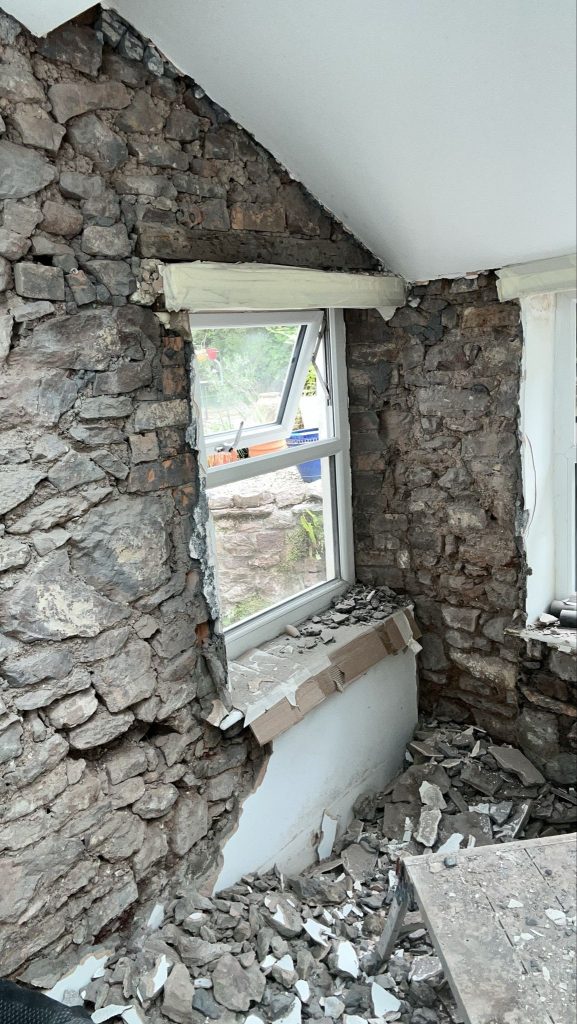
Ground sloping towards the building rather than away from it. Blocked, cracked or collapsed drains and gullies discharging into the soil beside a wall. Modern hard landscaping that has raised levels and removed the free-draining ground the building originally sat on. Water tables and springs, which matter more in some settings than others.
These are cheaper to correct than almost any treatment, and correcting them frequently resolves the problem entirely.
Rising damp, penetrating damp and condensation: telling them apart
Penetrating damp is by far the most common in listed buildings. It follows rainfall, appears in patches that can be traced back to a defect, and usually shows up on the elevation facing the prevailing weather.
Condensation has become far more common as owners have insulated, draught-proofed and blocked up chimneys. Old buildings used to be ventilated by accident, through draughty windows, ill-fitting doors and open flues. Seal all of that and the moisture from cooking, washing and breathing has nowhere to go. Black mould in corners, on cold external walls and behind furniture is the signature.
Rising damp is diagnosed far more often than it occurs. Salt-contaminated plaster, hygroscopic salts left by historic use, cement render trapping moisture and bridged ground levels all produce high moisture meter readings, and all of them get labelled rising damp by somebody in a hurry. Before accepting that diagnosis on a listed building, ask what else was ruled out and how it was ruled out.
Traditional fabric vs modern repairs: when “fixes” trap moisture
The pattern repeats itself so consistently that it is worth stating plainly. A building develops a damp patch. Somebody applies an impermeable material to stop the water getting in. The damp gets worse, because the water was already there and now it cannot leave. Somebody applies more impermeable material.
Breaking that cycle usually means removing something rather than adding something. Taking cement render off a stone wall and repointing in lime looks like an expensive way to treat damp until you understand that the render is the cause.
Consult with conservation officers
Contact the conservation officer at your local authority early, before you have committed to a contractor or a method, and before you have paid for anything.
Most conservation officers are helpful and pragmatic, and the large majority would far rather advise at the start than refuse an application later or serve an enforcement notice afterwards. Take photographs, a clear description of the problem, and ideally a survey report from somebody who understands traditional construction.
The framing of your approach matters. A proposal described as wanting to understand and resolve a moisture problem with minimal intervention to the historic fabric receives a very different reception to a proposal to inject the walls.
On consent itself, like-for-like repair using matching materials generally does not require it. Repointing in lime to match the original, replacing a broken slate with the same slate, or clearing a gutter are maintenance. You will usually need consent for anything that alters the fabric or the appearance, which includes injecting a chemical damp proof course into historic masonry, applying tanking or cavity drain membranes internally, removing historic plaster, changing the render type, or cutting through walls to install ventilation. When in doubt, ask rather than assume, because applying for consent is free and enforcement has no time limit.
Conservation-friendly treatments
The governing principle throughout is minimum intervention. Establish the cause, use materials compatible with the original construction, and do the least that will actually work.
In practice that usually means removing cement render and repointing in lime, replacing gypsum with lime plaster, using breathable mineral or clay paints, repairing and improving rainwater goods and drainage, lowering ground levels and adding French drains where the setting allows, providing controlled ventilation rather than sealing the building further, and gently improving the heating so that the fabric stays warm enough to dry.
Chemical damp proof courses, tanking and cavity drain membranes do have a place in some buildings, particularly in basements and in later phases of a building that were not traditionally constructed. They should be a considered decision taken after proper diagnosis and with consent where required, rather than the default recommendation offered on a first visit.

Specialist surveys and expertise
The most valuable thing you can buy for a damp problem in a listed building is an accurate diagnosis from somebody who understands traditional construction.
Look for a non-destructive approach using thermal imaging and humidity monitoring rather than drilling into historic fabric. Look for somebody who inspects the outside as carefully as the inside, who asks about heating patterns and how the building is occupied, who takes readings over a period rather than at a single moment, and who writes a report explaining the cause before proposing any treatment.
Be cautious of anybody who diagnoses rising damp from a hand-held meter within ten minutes of arriving and quotes for injection on the same visit. That is not a diagnosis, and on a listed building it can be an expensive mistake in more ways than one.
Why do listed buildings seem more prone to damp than newer homes?
They are not inherently more prone to it. They handle moisture differently, and they have usually been altered by owners who assumed otherwise.
A traditionally built house that has kept its lime mortar, its breathable finishes, its open flues and its original ground levels tends to be a comfortable and dry place to live, which is how it managed for two or three centuries before you bought it. The damp problems appear once somebody renders it in cement, plasters it in gypsum, seals the chimneys and lays a patio against the wall.
The good news in that is straightforward. Problems created by modern interventions can usually be resolved by removing them.
Nordic Damp Proofing carries out independent damp surveys on period and listed properties across the South Coast, the South Wales and the surrounding counties, using thermal imaging and full diagnostic equipment. If you own a listed building with a damp problem and want the cause identified before anybody touches the fabric, book a survey with us.