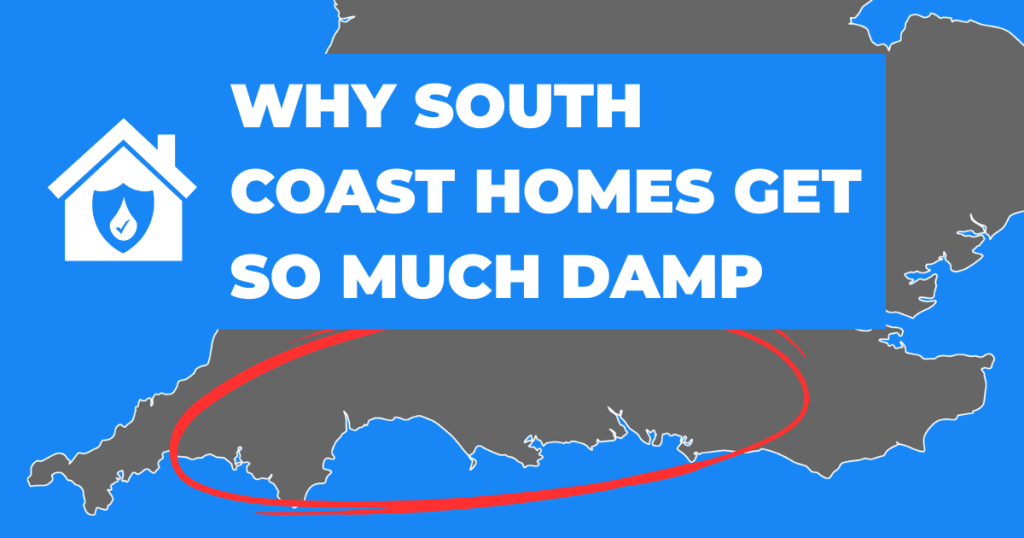
Southampton, Dorset and the Hampshire coast face unique weather and building challenges that trap moisture in homes. Coastal exposure means colder temperatures, higher wind speeds and increased risk of dampness. In practice, homes near the sea see more rain, storms and salt than inland. At Nordic Damp Proofing, we’ve learned that a perfect storm of climate factors, local construction styles, and common damp pathways makes our region unusually prone to damp.
South Coast Climate & Exposure
Gales & Storms:
The exposed south coast averages ~10 gale-days per year. Atlantic depressions often hit Hampshire and Dorset with driving rain and 50–80 mph winds. For example, Storm “Henk” (Jan 2024) brought 58–81 mph gusts and heavy rain to southern England, inundating rivers and battering coastlines.
Salt-Laden Winds:
Onshore winds carry sea spray far inland. Research shows salt spray travels ~25 km from the shore, depositing corrosive salt on walls. That salty spray…can stain and corrode exterior masonry over time. Combined with wind-driven rain, this cycle can strip paint and render off walls, leaving gaps for water ingress.
Heavy Rainfall:

Counties along the English Channel get pronounced autumn/winter rain peaks. Southern England records up to 950 mm/year on the Downs, and wet winters saturate soils. On the coast, penetrating damp is the leading cause of damp in coastal areas, since stronger, colder and heavier rain from the sea soaks into walls. In short, relentless downpours and saturated ground drive moisture straight into coastal homes.
High Humidity:
The South Coast’s maritime climate stays humid. Mild winters mean condensation lingers, and sea breezes keep air moist. Coastal homes often have less natural drying (no big dry summer months), so once water is in walls or roofs, it evaporates slowly.
Local Building Styles & Construction
The mix of home types on the South Coast influences damp risk. Common local builds include:
Thatched and solid-wall cottages:
Many rural Hampshire/Dorset cottages (often thatched or stone-built) date before the 1930s. These have solid single-skin walls with no cavity or modern damp course. Solid walls are porous, letting ground and rain moisture seep through easily. Likewise, thatched roofs must breathe – without proper roof ventilation, humidity builds up under the thatch. Experts warn that on old thatch, proper ventilation of the roof void is essential to prevent condensation and rot.
1930s–1940s semis and terraces:
Interwar suburban houses (e.g. Weymouth, Bournemouth suburbs) typically have masonry walls with early cavities. Over decades, failing mortar and pointing create cracks that admit rain. In terraces, especially, shared party walls and parapets can bridge moisture between houses. Terraced homes often “inherit” moisture – “every wall you share is one more moisture pathway”. Poor guttering or a leak in one house can push damp into the next.
1960s–1970s estates:
Postwar developments used blockwork and basic DPCs. Many 1960s/70s houses have concrete floors or strip footings; if these lack proper damp courses or if cavities are bridged (e.g. by rubble), rising damp can occur. Short UK guides observe that many mid-century homes were rushed, so simple defects (like missing damp-proof layers or cracks) allow moisture ingress.
Modern new builds:
Even brand-new homes face damp issues. Though typically cavity-walled with factory DPCs, any snag can let moisture in. For instance, Timberwise reports that bad mortar pointing on a new home will draw water into brick joints, allowing freeze-thaw damage and eventual penetrating damp. Likewise, inadequate ventilation in tight new houses causes condensation and mould. Home surveys warn: “Make sure…vents and air bricks are not blocked” to prevent mould spread. In short, poor workmanship or missing vents in new builds can turn a modern house damp surprisingly fast.
Typical Damp Patterns in South Coast Homes
Based on our South Coast experience, certain home types often show characteristic damp:
Seaside bungalows:
These low, single-storey houses (common on beach roads) often trap moisture. With all rooms on one level, bungalows have poor air circulation, so internal humidity (from showers, cooking or just people) condenses on cold walls and windows. Bungalows are more often prone to damp walls, mould and condensation than multi-story homes. Fortunately, most English bungalows (1930s–80s) have cavity walls and factory DPC, so true rising damp is rare. Instead, the issue is usually condensation, so we stress ventilation (trickle vents, extractor fans) in our diagnoses.
Terraced townhouses:
Urban terraced homes (e.g. Victorian or Edwardian streets in Southampton) suffer both penetrating and shared damp. As Sussex experts explain, moisture can cross party walls and up drains: even a gutter overflow two doors away can raise your interior humidity. Chimney stacks and roof valleys in terraces are also tricky spots where leaks cause penetrating damp if flashings fail. We find Victorian terraces especially need expert assessment: without original airbricks (some have been cemented over), condensation also worsens the problem.
Thatched cottages:

In coastal villages like New Forest or Christchurch, old thatch cottages need special care. Beyond the usual rising/penetrating damp issues of a 200-year-old stone wall, the thatch itself can hold moisture. Thatch normally insulates well, but only if the moisture underneath is vented. If, for example, loft vents have been removed or the thatch is piled with moss, we see damp rot in the roof timbers. Our treatments for thatch roofs always include checking/adding ventilation points.
Read our guide on thatched roof damp problems…
Basements and cellars (Southampton area):
Southampton and Portsmouth have many riverside homes with lower-ground basements. These spaces frequently suffer from water ingress or rising damp because of high water tables and flooding. In our experience, any house built on reclaimed marsh or near the Itchen/Test needs sub-floor waterproofing. We often install sump pumps or tanking in these cellars. (Southampton’s clay soils mean even new basement flats leak if untreated.)
Why Local Expertise Matters
A key lesson of our South Coast work is that local knowledge makes diagnosis and treatment far more effective. As one heritage surveyor puts it, as a local specialist we understand local climate conditions and building practices. For example:
- A Hamburg architect might not know that some New Forest soils swell when wet, but our local team does – so we check wall ties and foundation moisture accordingly.
- We know coastal wind patterns (e.g. prevailing SW gales) and exactly which elevations on a seaside house get the worst rain-blast. That means we target those walls with reinforced renders or extra flashing, rather than generic fixes.
- In terraced streets, we treat problems communally. Party walls can carry moisture between homes. So if we see damp in your middle-terrace, we’ll survey adjacent roofs and gutters, not just yours.
- Community trust and speed: Being based locally (Southampton/Bournemouth), we respond faster and understand council conservation rules (important for thatch or heritage walls).
In short, Nordic’s South Coast team tailors every survey and fix to our micro-climate. We don’t use one-size-fits-all “standard cures. Instead, we lean on area know-how at every step.
Nordic’s South Coast Solutions and Recommendations
Drawing on decades of regional experience, we customise damp-proofing for local conditions:
Salt-resistant weatherproofing:
We use exterior coatings proven for sea air. For instance, specialist silicone/cork renders (e.g. SprayCork) neutralise salt and won’t degrade under constant spray. Tests show such coatings do not react to salt, with 25-year durability. Our Industry experts agree: coastal homes need high-performance coatings…that resist salt, moisture, and fungal growth. Nordic applies these breathable textured renders (not hard, impermeable paint) so wind-driven rain can’t simply erode the finish.
Breathable damp-proof courses:

In old solid-wall houses, we avoid rigid tanking that traps moisture. Instead, we inject modern chemical DPCs and then use lime-based or silicone-modified renders. This lets any trapped ground moisture evaporate harmlessly. Victorian solid walls can wick up water unless properly rendered, so we choose materials that allow ‘breathing’. In the New Forest and Purbecks, we regularly apply lime washes and natural coatings after injection, preserving traditional wall fabric.
Ventilation improvements:
We add or check vents in every survey. Modern airtight houses and bungalows often lack trickle vents or have ineffective fans. We heed Timberwise’s warning that blocked vents lead to condensation and black mould, so we retrofit window vents or mechanical extractors where needed. For historic homes, we might install passive air bricks or a PIV (Positive Input Ventilation) unit to gently push fresh air through the roof space. Good ventilation is a cheap but crucial fix to stop internal damp (especially in 1–2 storey coastal homes).
Drainage and sump pumps:
Wherever groundwater is an issue (flood-prone sites in Southampton, Portland cement basement floors, etc.), we install waterproof membranes and sumps per BS 8102. For example, many Southampton basements need cavity drainage systems along all walls; Nordic designs these to manage the local water table. We also advise on ground levels – keeping patio slabs and landscaping sloped away from walls, as coastal clay soils can channel water otherwise.
Each recommendation comes from what we’ve seen work on the South Coast. Whether it’s a Lyme Regis fisherman’s cottage or a new bungalow on Portland, our fixes account for coastal rain, salt and building quirks.
That’s why South Coast homeowners trust Nordic Damp Proofing for truly local damp solutions.