(And Why You Might Be Wasting Time and Money)
Dryrods are one of the most common DIY products marketed for treating rising damp. They’re widely available, promise minimal mess, and sound like a quick fix — just drill some holes, insert the rods, and damp-free walls await. But here’s the problem: they often don’t work as expected.
At Nordic Damp Proofing, we’re regularly called out to survey homes where Dryrods (or similar products) have been installed but damp is still clearly present. In most cases, the issue lies not with the product itself, but with how and where it’s used.
Let’s unpack why Dryrods need very wet conditions to be effective — and why proper damp diagnosis matters far more than DIY treatments.
What Are Dryrods?
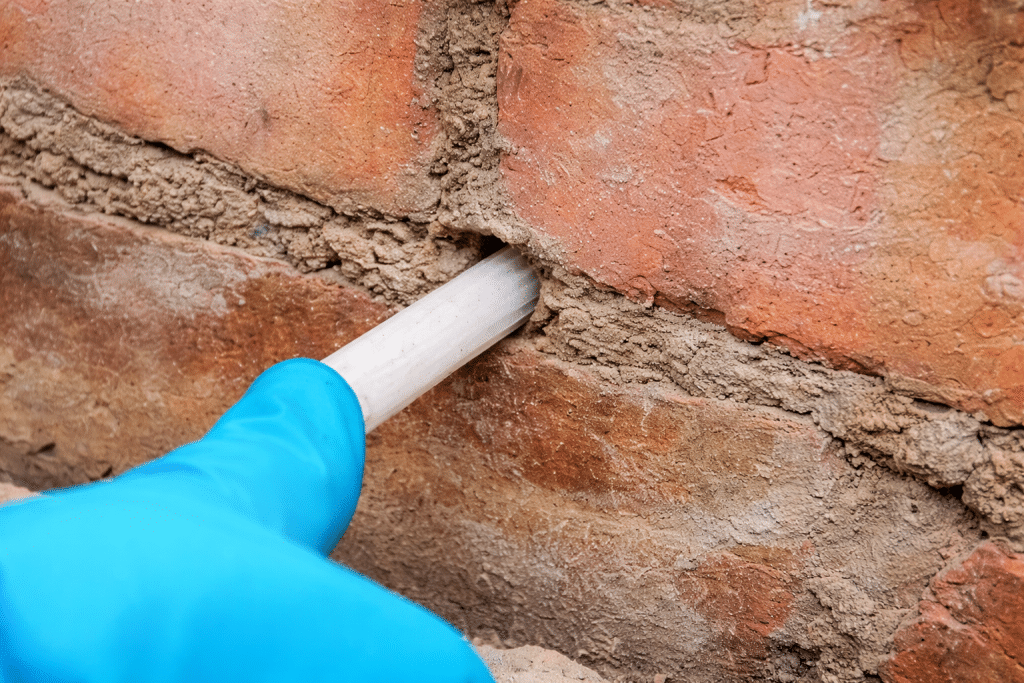
Dryrods are rigid damp-proofing rods pre-loaded with a silane/siloxane cream. Once inserted into drilled holes along a horizontal mortar bed, they’re designed to release the active damp-proofing ingredient slowly into the masonry. This chemical then lines the pores in the bricks and mortar, forming a water-repellent barrier to block rising damp.
It’s a variation of traditional DPC injection but with a different delivery mechanism.
The Key Issue: Dry Walls = No Absorption
The main reason Dryrods fail is that they rely entirely on capillary action to disperse the active ingredient. In simpler terms, they need the wall to be actively and uniformly wet for the chemical to spread into the surrounding brick and mortar.
If the wall is too dry — or has dried out unevenly — the chemical doesn’t get drawn into the masonry. Instead, it just sits inside the drilled hole or gets absorbed in small patches, leaving gaps in the barrier and allowing moisture to continue rising.
In fact, the original manufacturer’s data shows that Dryrods are only fully effective when installed into highly saturated masonry, typically >95% saturation. This is very rare in real-world conditions, especially in cavity walls, walls with dense render, or where drying has already occurred at surface level.
Why DIY Dryrods Don’t Fix the Problem
Many homeowners install Dryrods after seeing a damp patch or tide mark, assuming it’s rising damp. But here’s what often goes wrong:
- The wall isn’t wet enough, so the rods don’t distribute their contents properly.
- It’s not rising damp at all – the issue could be condensation, penetrating damp, or hygroscopic salts.
- Plaster is contaminated, so even if rising damp is stopped, the wall keeps attracting moisture.
- No bridging issues are resolved – such as high external ground levels or blocked cavities.
As a result, people spend money, drill into their walls, and think they’ve treated the problem… only for the damp to reappear months later.
When Dryrods Might Work
To be clear, Dryrods can work if:
- The wall is genuinely affected by rising damp.
- The masonry is highly saturated and has no dense coatings like waterproof render or paint.
- The application is done precisely to spec (hole depth, spacing, wall thickness).
- Salts are removed, and the wall is properly re-rendered with breathable plaster.
But these conditions are hard to assess without professional tools. And in many homes, they’re simply not met — making the treatment ineffective.
What We Recommend Instead
At Nordic Damp Proofing, we strongly advise against guesswork. Instead, we offer:
1. Full Damp & Timber Surveys
We use calibrated moisture meters, thermal imaging, and hygroscopic salt testing to determine the exact cause of your damp. You may not even need a chemical DPC — the problem could be surface condensation, damaged gutters, or bridged insulation.
2. Professional Damp Proof Course Installation
If rising damp is confirmed, we’ll install a guaranteed DPC using the correct method for your property. That might include pressure injection, Dryzone cream (for moderate saturation), or physical DPC options for affected properties.
3. Salt Removal & Replastering
Dryrods or not, if the plaster is contaminated with salts, it must be removed and replaced with a breathable, salt-resistant render. Skipping this step is why many DIY DPCs seem to “fail.”
Damp Isn’t a Guessing Game — It’s a Science
Diagnosing damp is more than finding a wet patch. It involves understanding wall construction, moisture movement, and the impact of humidity, ventilation and insulation. That’s why we’re called in to inspect homes where “quick fixes” like Dryrods didn’t work.
As PCA-trained specialists serving the south coast — including Southampton, Bournemouth, Portsmouth and Bristol — we help homeowners get the right fix the first time.
Book Your Damp Survey Today
If you’ve tried Dryrods and your walls are still damp, don’t wait for the problem to worsen. Book a professional survey with Nordic Damp Proofing and get clear, honest answers.
We’ll find it, we’ll treat it — and we’ll stop it coming back.
Free quotes available for homeowners and landlords. 25-year guarantees provided on qualifying work.