The honest answer is sometimes.
A French drain can be very effective when damp is being driven by surface water, high external ground levels, splashback, uphill runoff, or lateral moisture loading against a wall. It can also help where a damp-proof course has effectively been bridged by soil, paving, render, or landscaping.
But a French drain does not replace a damp-proof course, and it does not cure every form of damp.
If the real issue is true rising damp, condensation, plumbing leaks, or hygroscopic salts, a trench outside will not solve the root cause. That is why Nordic Damp Proofing always recommends a proper survey before any digging starts.
What a French drain is and how it works
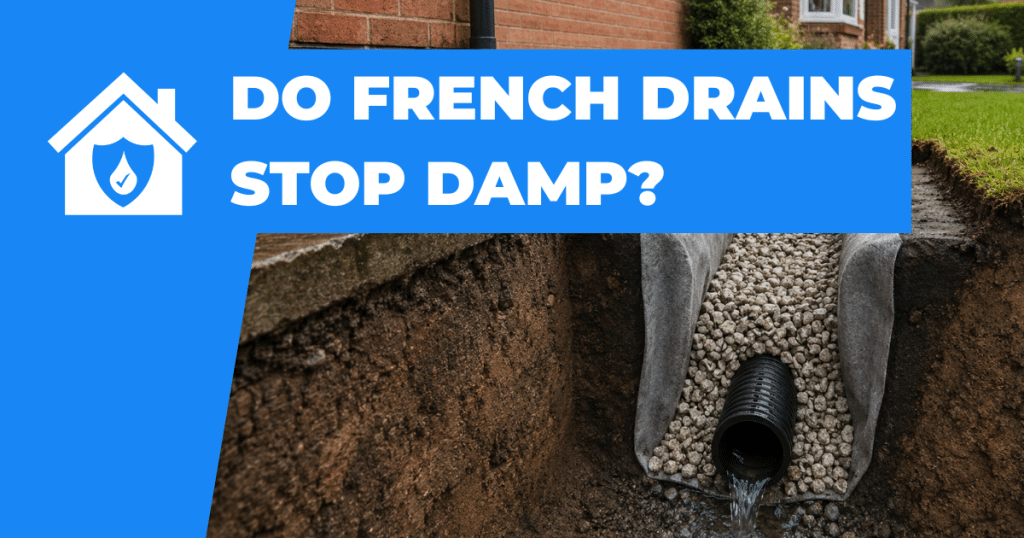
French drain as a perforated pipe laid in a shingle-filled trench, usually lined with a geotextile filter membrane, with the pipe laid to a fall of about 1:80 and typically sized around 100 to 150 mm in diameter.

Good installations include frequent rodding points and discharge water to a soakaway, watercourse, or drainage system.
The physics are simple. Water moves toward the route of least resistance and then follows gravity to a lower outlet.
A correctly built French drain gives water an easier path than the base of a wall, so instead of sitting against masonry and saturating surrounding soil, it is intercepted and redirected. That is why French drains can be so useful for preventing penetrating damp at low level, reducing saturation around shallow foundations, and easing moisture pressure beside ground-bearing walls.
French drains are not the answer in every case. In certain circumstances, by redirecting surface and subsoil water, gravel-encased perimeter drains close to walls can actually concentrate water at the base of a building or undermine shallow foundations if badly conceived.
Where French drains make sense in Bournemouth, Poole, Christchurch, Bath, Bristol, Dorset, and Hampshire
Questions about French drains come up a lot in Bournemouth, Poole, Christchurch, Bath, Bristol, and across Dorset and Hampshire because these are all places where surface water, groundwater, or flood-related moisture loading are real property issues.
BCP Council’s strategic flood work says Poole and Christchurch require Level 2 flood-risk assessments because of their tidal and fluvial risk.
Bath and North East Somerset and Bristol both say their local flood responsibilities include surface water and groundwater.
Hampshire has a formal Groundwater Management Plan, and Dorset Council warned in early 2026 that groundwater levels had reached historic highs.
The broader context matters too. The Environment Agency says around 6.3 million properties in England are in areas at risk of flooding from rivers, the sea, surface water, or combinations of those sources, and its groundwater guidance explains that cellars and basements are especially vulnerable when the water table rises. Groundwater flooding is more likely in chalk, but it also occurs in sand and gravel, and it can emerge on hillsides as well as in valleys. That makes perimeter drainage particularly relevant on sloping sites, around retaining walls, beside basements, and at the foot of older solid walls where surface water or perched groundwater is repeatedly collecting.
In practice, Nordic Damp Proofing most often sees French drains discussed for homes with raised flower beds or paths against walls, coastal or exposed plots where water repeatedly sits at the base of masonry, older properties where the original ground level has crept upward over decades, and buildings with cellars, lower-ground rooms, or vulnerable timber ends. That does not mean every such property needs a trench. It means those are the conditions where external drainage is worth investigating before anyone jumps straight to injected DPCs or internal tanking.
What a french drain compliant installation actually looks like
There is no single household rulebook called “French drain compliance” in the same way there is for a boiler or consumer unit. But there are clear expectations from drainage guidance, damp guidance, and building practice. Approved Document C says buildings must resist moisture and that ground moisture should be contained and removed using suitable drainage. Meanwhile, the Property Care Association says good building practice places a damp-proof course at least 150 mm above external ground level.
In other words, a proper installation is not just “dig a trench and throw in gravel”; it has to preserve DPC clearance, drain to a real outlet, remain maintainable, and avoid damaging the structure.
The table below is a synthesis of good practice…
| System part | Poor spec or DIY risk | Good practice for a Nordic-style installation |
|---|---|---|
| Pipe fall | Guessed by eye or laid flat, so water stalls | Set to a measured, continuous fall with a defined discharge route |
| Pipe and trench | Undersized coil in a muddy trench | Perforated land drain sized to the site, set within a properly excavated trench |
| Aggregate | Mixed rubble, scalpings, or dirty gravel that silts up fast | Clean, free-draining stone or shingle around the pipe |
| Membrane | Omitted, torn, or wrapped badly | Geotextile filter membrane used to limit sediment ingress |
| Access | No catchpit, no rodding, impossible to maintain | Catchpit or rodding access built in and left reachable |
| DPC relationship | Gravel or paving finished too high, bridging the wall base | Finished external level kept below the DPC and air bricks |
| Heritage and foundations | Trench cut tight against shallow footings | Set back from vulnerable walls where needed, or redesigned as an open drain / alternative detail |
| Outlet | No legal or practical discharge point | Water sent to a suitable soakaway, drainage system, or other approved outlet |
Will a French drain stop rising damp?
Not by itself, and that is the part many property owners are not told clearly enough.
A damp-proof course is a continuous barrier intended to stop the capillary rise of water through masonry.
A French drain does not create that barrier. So if you have true rising damp, a drain outside the wall is not a direct substitute for a functioning DPC. That conclusion follows from PCA’s definition of what a DPC does.
Where the confusion starts is that a lot of “rising damp” diagnoses are not true rising damp at all.
We stress a whole-building approach and warn against relying on simplistic or misleading indicators. Low-level damp can just as easily be caused by raised external ground, splashback, bridged render, trapped evaporation, lateral moisture, or poor drainage. In those cases, a French drain and lowered ground level can make a major difference because the problem was external moisture loading, not capillary rise through the wall fabric.
So the precise answer is this: a French drain can help solve what looks like rising damp if the diagnosis was actually wrong or incomplete. It is a very useful tool for preventing penetrating damp and preventing DPC bridging, but it is not a universal cure for all low-level damp.
Why French drains fail and where their limits are
French drains usually fail for boring reasons rather than mysterious ones:
- The fall is wrong
- The outlet is blocked or nonexistent
- The trench fills with silt because there is no membrane
- There is no maintenance access
- The gravel sits too high and bridges the DPC
- The trench has been cut hard against an older wall that really needed a stand-off, a catchpit, or even an open drain instead.
They also fail when people expect them to do a job they were never designed to do. If your issue is internal condensation, the PCA says the likely causes are excess moisture generation, inadequate heating, and poor ventilation. If your issue is active groundwater flooding, the Environment Agency says water can rise through floors and into cellars for weeks or months, and pumping or more sophisticated drainage may be needed. If timber has already been exposed to chronic moisture, decay can continue until the wetting source is genuinely controlled. In those situations, a French drain may be part of the answer, but it is rarely the whole answer.
That is why professional drainage beats guesswork. DIY work often looks acceptable from the top but misses the hidden essentials: fall, discharge, filter strategy, DPC clearance, groundwater context, and whether the property actually needs drainage, waterproofing, ventilation, or repairs to the wall and rainwater goods instead.
Why Nordic Damp Proofing starts with the survey, not the trench
At Nordic Damp Proofing, the first question is never “Do you want a French drain?” The first question is “Why is the wall getting wet?” That is the only sensible starting point.
Nordic’s Damp Surveys include external inspection, moisture diagnostics, thermal imaging, and a photographic report by trained surveyors and diagnostics aimed at finding the root cause before treatment is specified.
That approach matters because the fix may turn out to be a French drain, but it may just as easily be lowering a bridged path, repairing a rainwater defect, specifying a Penetrating Damp Treatment, improving ventilation, or preventing timber damage before it escalates.
We also offer dedicated Timber Treatment Services and Ventilation & Condensation Surveys, which is exactly the kind of joined-up thinking damp problems usually require.
So, do French drains stop damp?
Yes, when the damp is being driven by water outside the wall and the drain is properly designed, positioned, and maintained.
No, when the problem is true rising damp, condensation, salts, leaks, or uncontrolled groundwater pressure.
If you are dealing with recurring low-level damp, the honest route is to book a survey first, then decide whether you need a French drain, a DPC solution, or something completely different. For most homeowners, that is the fastest way to avoid paying twice for the wrong remedy.